
Forgets Me Not
Life, Death, Gardens, Fathers, Poetry, Heaven

I’m surprised how many poems I have written about death. I’m not a morbid person. I love life. But when you live life for very long at all, you encounter death. People die. Pets die. Plants die. Dreams die.
Why not write about death? Afterall,
Christ’s death and resurrection reside firmly at the center of the faith I affirm and aspire to live.
St Paul declared “I die daily.”
Jesus said, “unless a grain of wheat falls into the earth and dies, it remains just a single grain; but if it dies, it bears much fruit.”
I believe in the communion of saints that permeates the barrier between this life and the next.
Most days, I spend some time in my gardens. There, as in all nature, I am reminded that death and life are a continuous cycle. Dying, decaying things nourish new life. And soil, which maybe people consider dead as well as dirty, is actually teaming with life.
These are great themes to inspire poetry. Stated differently, perhaps poetry is the best way to express the relationship between life and death, the mystery and the hope that encompasses it all.
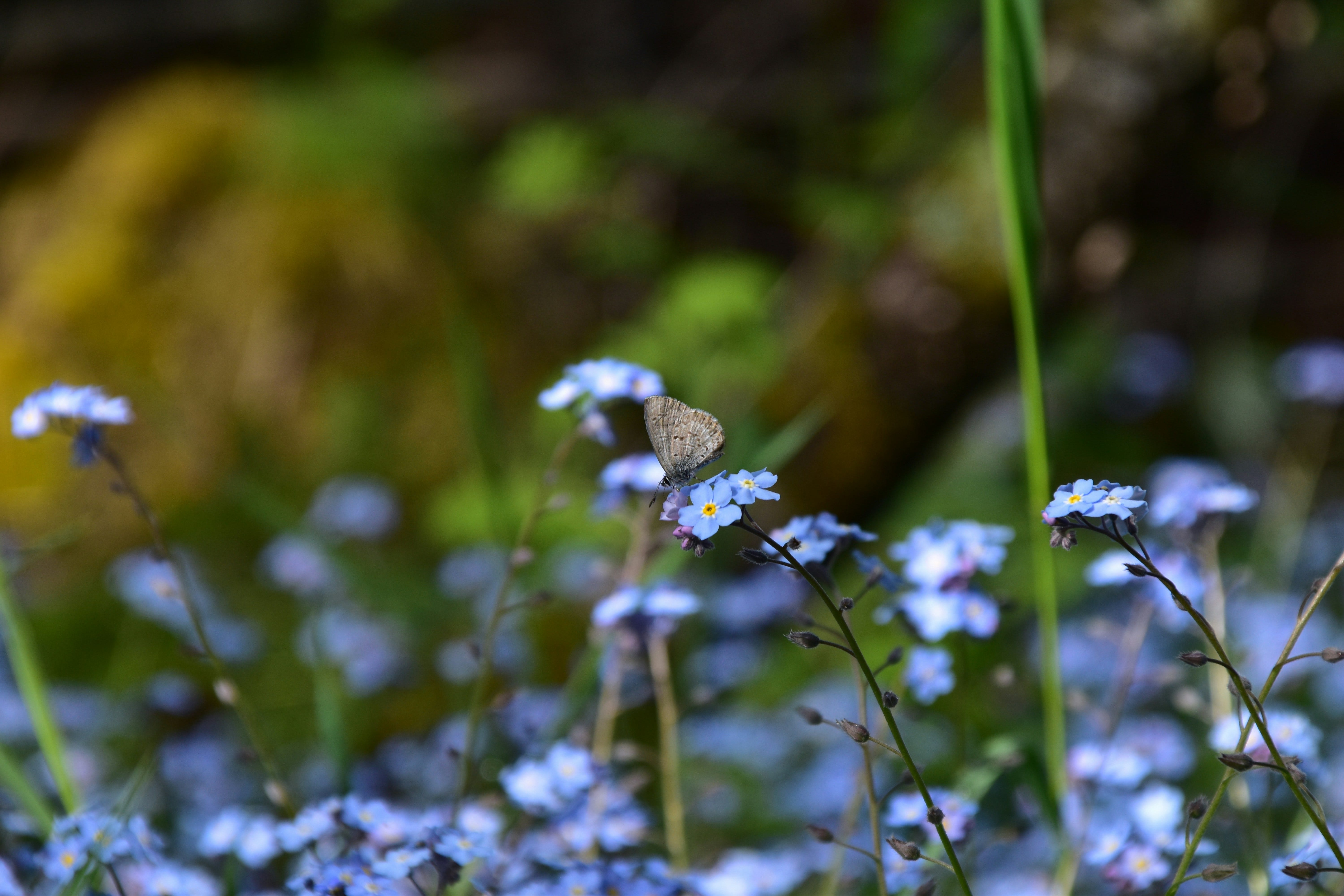
When my father died seven years ago, forget-me-not seed packets were handed out at his memorial service by a young niece who knew his love of gardening and growing flowers. I came back home and planted the seeds. Next spring the sweet blue flowers bloomed and prompted thoughts of my father every time I stepped outside.
The flowers also remind me that someday I will die. What legacy do I want to leave for my children? Such thoughts gave impetus to this poem:
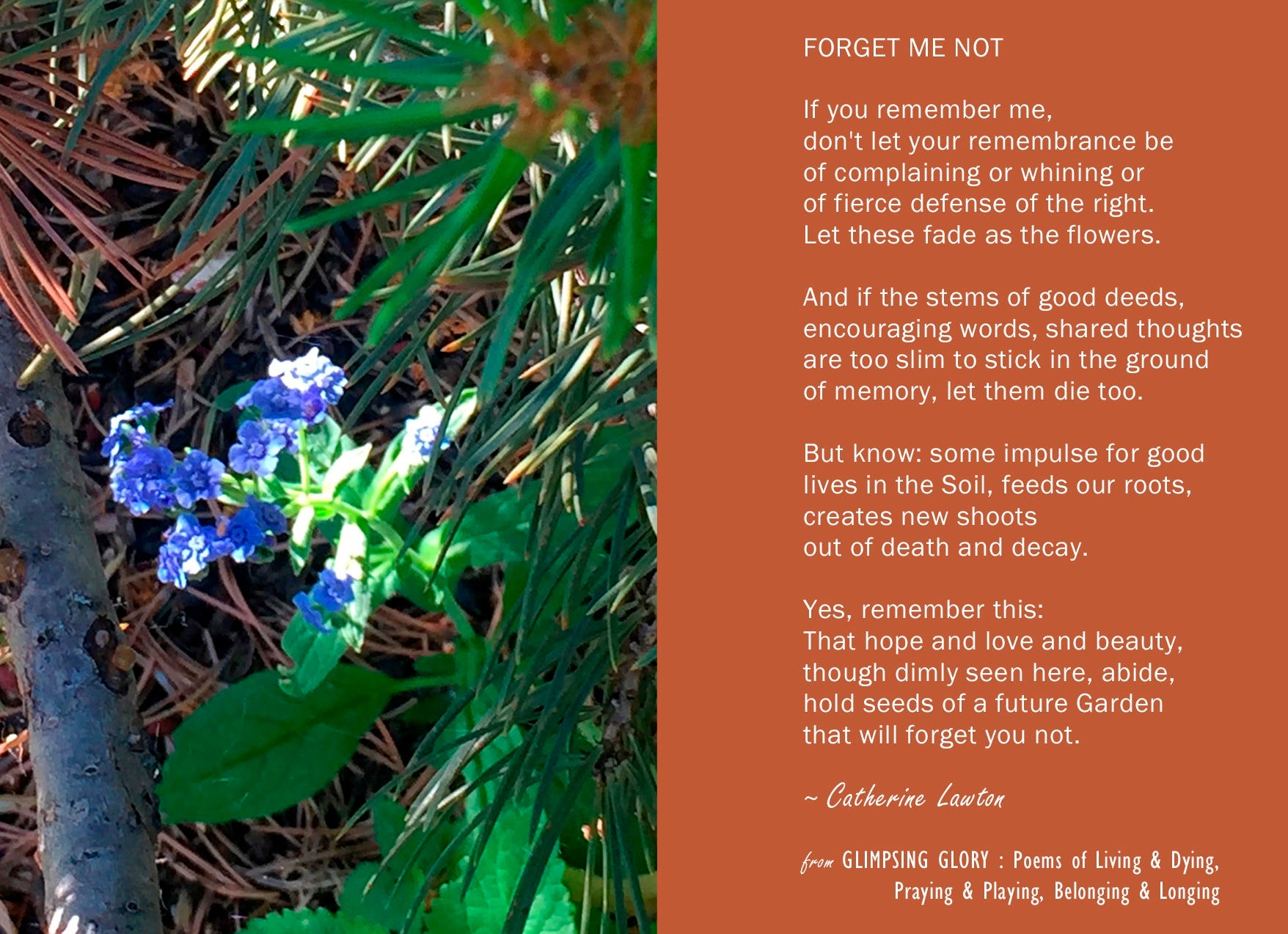
     If you remember me,
     don’t let your remembrance be
     of complaining or whining or
     fierce defense of the right.
     Let these fade as the flowers.
     And if the stems of good deeds,
     encouraging words, shared thoughts
     are too slim to stick in the ground
     of memory, let them die too.

     But know: some impulse for good
     lives in the Soil, feeds our roots,
     creates new shoots
     out of death and decay.

     Yes, remember this:
     that hope and love and beauty,
     though dimly seen here, abide,
     hold seeds of a future Garden
     that forgets you not.
Death is an end but also a beginning. Surely it is a principle of God’s creation and God’s realm (I like the term “kin-dom”) that death always brings potential for new life. Both life and death are active in a flourishing garden.
This year my father would have turned 101. Do the saints have “heavenly birthdays?” If so, this is how I imagine it …
Daddy is celebrating in a lush garden of vegies, fruits, and flowers (he liked to mix them in his amazing earthly gardens). A sparkling stream is flowing nearby with trout jumping and flashing silver in the sunshine. Deer and birds and other wildlife have certainly come (not to mention several pet dogs and his favorite horse growing up on the farm). Also present are countless family members, friends, and past parishioners. They will share memories, recount victories, discuss inspired books, sing hymns, quote poetry, give praise to the creator and redeemer, and express wonder over the beauty that surrounds them. Perhaps they’ll offer a prayer of faith for us as they pause to think of us and cheer us on… 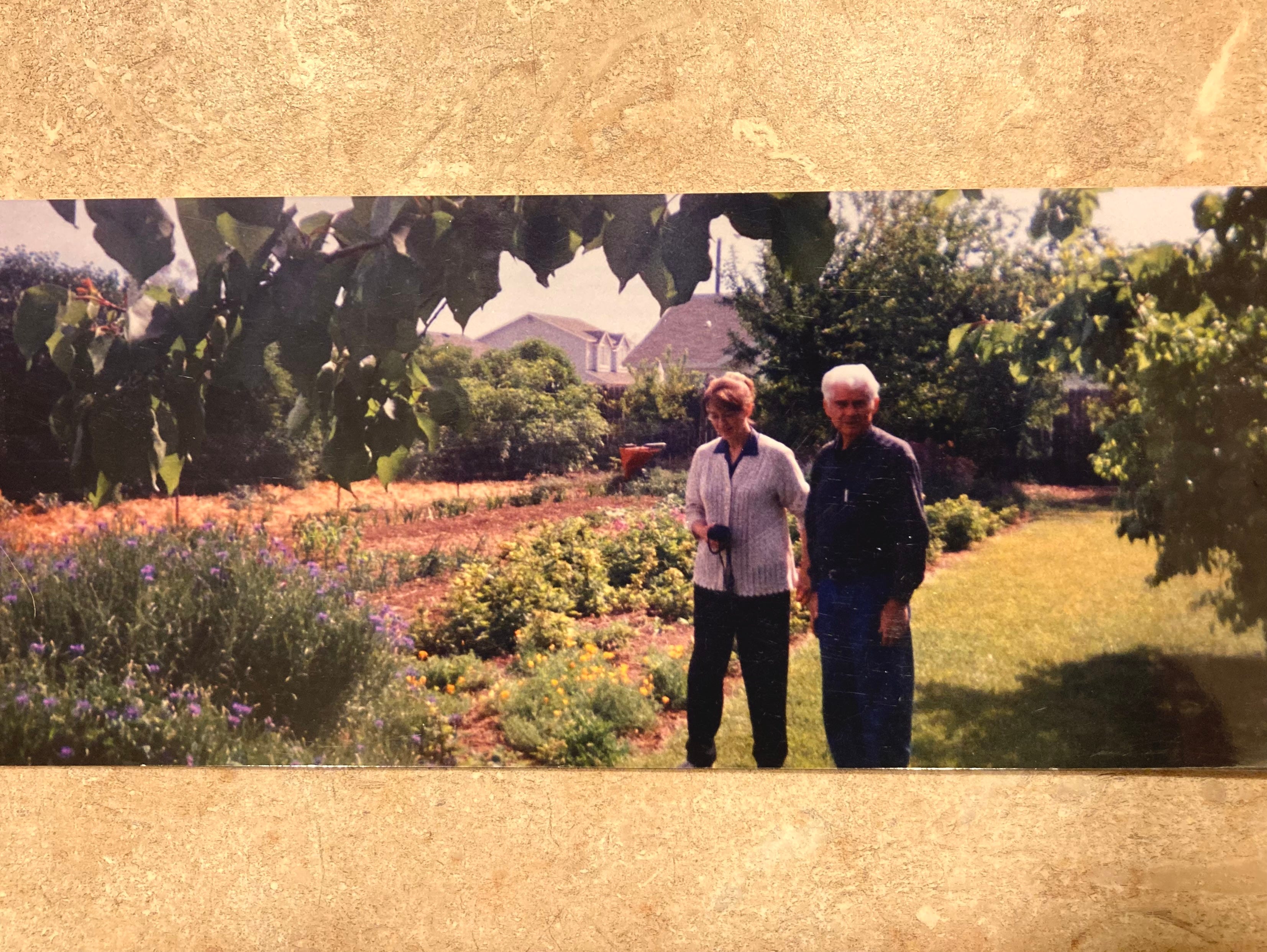
After he died I woke one morning with Psalm 16:11 on my mind:
“You make known to me the path of life. In your presence there is fullness of joy, at your right hand are pleasures forevermore.”
Through my father God made known to me “the path of life.” As a little girl when I cried from night terrors and couldn’t sleep, Daddy placed his large, warm hand on my head and prayed. I began to relax and go to sleep.
When I turned 9, he gave me my very own leather, zippered Bible. He told me to read the Psalms and Jesus’ words printed in red letters. He told me God would speak to me through the words.
At various stages in my life, he offered wise, succinct, and timely advice. As I practiced piano at 12, he gently suggested, “Why don’t you try listening to your music as you play?” I’m sure I became more careful about hitting the right notes and producing a more beautiful sound. He gave me books and offered pithy suggestions as I pursued education, got married, kept house, served in church and community, raised children, and sought to use my gifts. He helped me pay attention with fresh perspectives.
I have saved and cherished his letters. I loved his visits and our walks and talks together. Even at the last, when dementia had taken much of his ability to process and articulate thoughts, his faith and love came through strong and clear. In our last, short phone conversation, he began mumbling an impassioned progression of words, which ended clearly with, “Amen.” Then I realized he had been saying a prayer for me. I thanked him.
“Ove u,” he said.
“I love you, too, Daddy.”
He also taught me about the “fullness of joy” to be found in God’s presence. His growing up years were harsh, often visited by hardship. He experienced injustices in the pastoral ministry. He suffered life losses and grief. But he kept going, kept starting new projects, which he pursued with energy and cheerfulness. He kept loving people and all living things. He kept serving and helping others as a minister, as a counselor, as a neighbor and friend.
I believe—as he believed and set his hopes upon—that he is continuing in the presence of the Lord at whose right hand there are “pleasures forevermore.” I don’t suppose those pleasures, in that mysteriously far-but-close realm, include a birthday celebration. But just in case, Happy Birthday, Daddy!

I remember your Dad as a kind person.